
Choosing between a longer axe and a compact hatchet is not about preference or tradition. It is about energy transfer, control, and task efficiency. Handle length changes leverage, swing arc, and fatigue patterns. In camp-related tasks, these factors decide whether a tool saves effort or creates unnecessary strain. Understanding where length helps and where it becomes a liability allows better tool selection for real use, not theory.
What actually changes when the handle gets longer
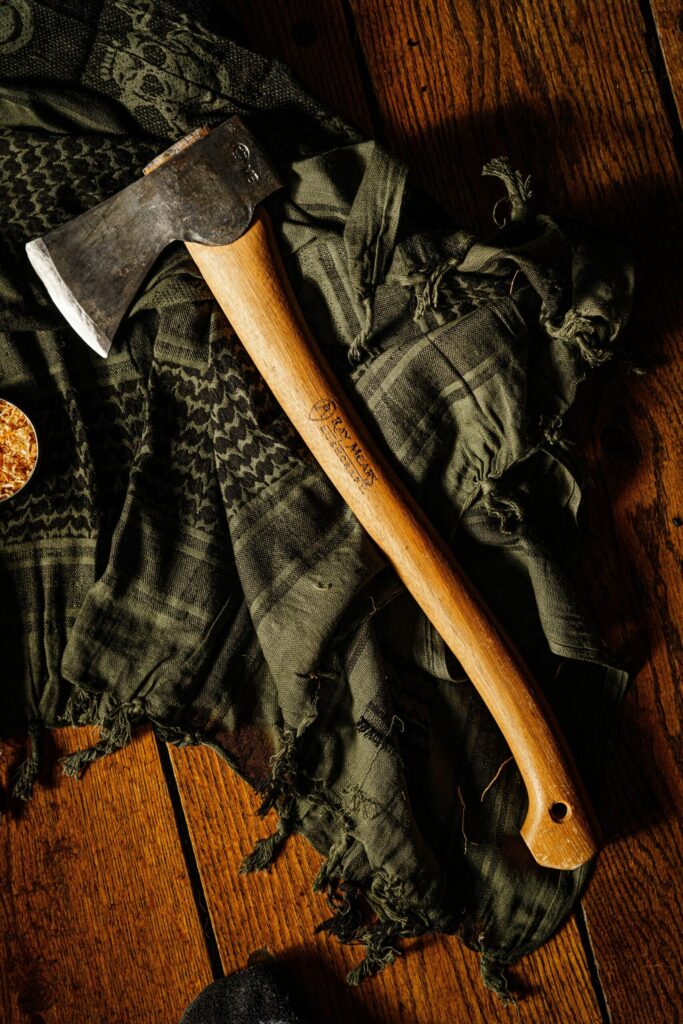
A longer handle increases leverage and swing speed. This is the primary advantage of a bush axe. The longer arc allows more kinetic energy to reach the cut with less muscular effort per swing. In controlled conditions, this reduces the total number of strikes needed for a task.
Control generally decreases as length increases. A longer handle amplifies small errors in angle and timing. At shorter distances, accuracy suffers compared to a bushcraft hatchet. This becomes noticeable when cutting close to the body or working on uneven material.
Fatigue depends more on technique than weight alone. A longer tool can reduce fatigue during repetitive chopping if the swing is efficient. Poor technique leads to overswinging and wasted motion. In those cases, a medium-length camp axe often performs better than very short or very long tools.
Typical jobs where a bush axe is more efficient
Length shows its advantage in tasks that benefit from momentum and clearance. Bush axes excel when the work area is open and the footing is stable.
- Limbing branches along a fallen trunk where reach reduces repositioning.
- Processing wrist-thick firewood with fewer total swings.
- Clearing brush without bending or crouching.
- Camp chores performed repeatedly in one fixed location.
- Situations where controlled power matters more than fine accuracy.
In these jobs, bushcraft axes reduce effort over time. Compared to short tools, they maintain cutting speed without increasing strain when used correctly.
When a hatchet is the better tool
Shorter tools favor precision and flexibility. A bushcraft hatchet allows close control and safe one-handed use. It performs better for carving, notching, and controlled splitting.
Tight spaces favor compact tools. Inside shelters, near the ground, or around other people, a camping axe hatchet setup reduces risk. Carry weight also matters. For long-distance movement, bushcraft hatchets are easier to pack and less tiring to carry than longer camp axes.
The situations where extra length does not help
Longer handles lose their advantage when conditions reduce stability. Wet wood, uneven footing, or awkward angles make accuracy more important than power. Over-swinging becomes common, increasing missed cuts and edge damage.
Length does not compensate for poor geometry. Knots and twisted grain require a proper wedge shape and edge profile rather than leverage. In these cases, even large bush axes perform worse than well-designed bushcraft hatchets with proper head geometry.
How to choose based on your style of camping
Tool choice should reflect how you move and work in camp.
- Base camp setups benefit from a bush axe or camp axe for repeated processing.
- Moving camps favor lighter bushcraft hatchets for carry efficiency.
- Group camps can share larger bushcraft axes while individuals carry smaller tools.
- Solo trips benefit from one versatile tool rather than specialization.
- Common combinations pair a medium bushcraft axe with a compact hatchet.
No single tool fits all conditions. In practical axe bushcraft, efficiency comes from matching length, task, and movement pattern, not from maximizing size.