
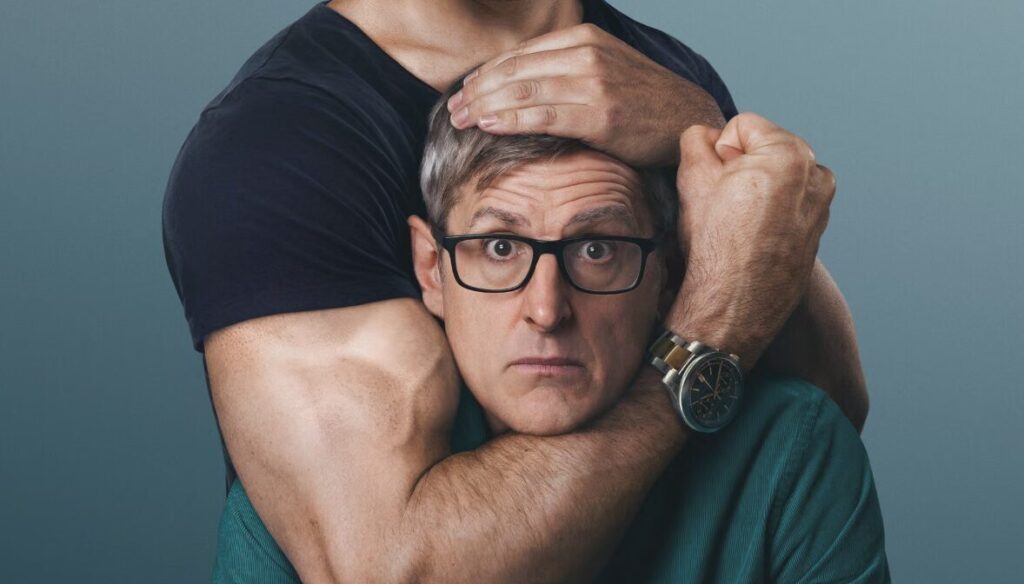
Last week, my boyfriend and I (along with everyone else on the internet) watched the new Netflix documentary Louis Theroux: The Manosphere.
If you haven’t come across it yet, it’s exactly what it sounds like: Louis Theroux wandering calmly into the internet’s weirdest male self-help ecosystem and, between long pauses of awkward silence, politely asking questions while everyone slowly reveals far more about themselves than they intended.
If you’re unfamiliar with the manosphere, then congratulations. Your algorithm is healthier than most, and definitely a nicer place than mine.
The manosphere is a loose online universe of podcasters, influencers, dating ‘coaches’, and self-declared alpha males who promise to teach men how to succeed with women, success and masculinity. What they mostly seem to teach is how to blame everything on women.
I watched the whole documentary so you don’t have to, although honestly, you probably still should, because it’s funny, awkward, and occasionally so bleak you start wondering if we really should make the internet available to everyone quite so freely.
The basic premise
The documentary follows Theroux as he explores the world of ‘online masculinity influencers’, who are – surprise! – unilaterally awful people.
Think podcasts with neon signs, men explaining ‘female psychology’ despite clearly never having spoken to a woman who wasn’t paid to be there, and an entire industry built around convincing lonely men that women are incredibly powerful, extremely stupid, worthless and also the ultimate prize.
There are appearances from various misogynistic manosphere personalities with stupid names like HSTikkyTokky (really), Sneako and Myron Gaines, a name he literally gave himself which happens to be one letter away from Moron.
The shadow of chinless Andrew Tate, a shaved bollock of a man, looms over the whole thing but much like Nigel Farage being challenged to a debate with the Green Party he knows he is too ill-equipped to win, he declined to appear. Shame.
Theroux does what he always does best: he listens politely, asks quiet questions, and lets people talk until they accidentally reveal the exact problem with everything they’re saying. Occasionally he can’t quite keep it in and laughs at their ridiculousness, which annoys them enormously and makes us, the viewer, fall ever so slightly more in love with him.
The funniest bits
Like most Louis Theroux documentaries, there are moments that are genuinely hilarious. Not necessarily because the subjects are trying to be funny, but because the absurdity sort of unfolds on its own.
Take HS, a man barely out of high school, with ridiculous facial hair and a rental in Marbella that looks like it was decorated by the Live Laugh Love final boss.
At one point he’s there with his mum hovering nearby while he complains, like an irritated toddler: “Mummy, I don’t want a juice bar!”
This is a man who brands himself as some sort of hyper-masculine guru to thousands of young men online, and yet the vibe is very much six-year-old being dragged around Waitrose.
You learn he’s in Marbella largely to avoid the fallout from a car crash in the UK, and suddenly the whole thing starts looking less like harmless internet nonsense (boys will be boys, right?!) and more like the grubby little grift it is.
The kind where someone who can still get a bollocking from his mum is being paid by other men to tell them how to run their lives, while giving damaging financial advice he is in absolutely no position to be giving, all in the name of making bank.
Which leads to one of the saddest parts of the whole documentary.
Theroux speaks to two of HS’s followers, both younger than him. One of them has apparently sunk money into one of HS’s schemes, which has somehow failed to make him a millionaire, and has been living in his car.
He proudly announces that he doesn’t believe in depression, which feels like a bold philosophical stance from someone who’s been sleeping in a Ford Fiesta. Then he mentions, almost in passing, that his brother took his own life.
It’s one of those moments where the entire tone of the documentary shifts. The bravado, the talk about dominance and mindset, suddenly looks like exactly what it is: a thin layer of internet nonsense sitting on top of some very real pain.
Still, since the documentary – where HS came accross as a spoilt, overconfident little brat, stealing from younger men to make a living and treating women like shit – he’s cleansed his Instagram and is shouting loudly about unfair editing, which you love to see.
Theroux manages to inject moments of perfectly timed awkwardness.
At one point he casually tells HS that his calves need work, which is the sort of oddly specific observation that Louis Theroux delivers with such calm politeness it somehow becomes devastating.
Another standout is the podcaster Myron Gaines, who runs one of those manosphere shows where women are invited on purely so they can be insulted by a panel of men with microphones and a neon sign.
He spends most of his time explaining how women think, what women want, and why modern women are the problem. Unfortunately for him, he appears to have been spectacularly unprepared for the possibility that someone might ask him basic follow-up questions.
Theroux does very little. He just sits there, mildly curious, occasionally raising an eyebrow, and lets Gaines talk himself into increasingly uncomfortable corners.
Which makes the final reveal quietly satisfying: The man who claims to have completely decoded female psychology ends up with his girlfriend leaving him.
Chef’s kiss.
Justin Waller: the least awful alpha (which isn’t saying much)
The least viscerally horrific ‘apha male’ featured in the documentary is Justin Waller.
Now don’t get me wrong, he’s still a horrible little prick, but compared to some of the others he almost feels like the entry-level villain: He’s ginger, quite short, and gives off the general impression of a man who is fighting some fairly loud internal demons.
At one point he confidently announces: “Men invent, build and maintain society. That’s a fact. Can you name anything a woman has invented or built that we see in plain sight?” – Which is a bold claim, considering that women have in fact invented quite a lot of things. Kevlar. Wi-Fi technology. The foundations of modern computer programming; not exactly niche contributions to humankind.
But even if we ignore that inconvenient reality for a moment and pretend men did invent literally everything in the world, that argument still doesn’t work. You can’t claim personal superiority by proxy. You don’t get credit for the achievements of other men simply because you share a chromosome configuration with them. That’s not how success works.
Having a podcast is not the same thing as building a civilisation.
My overall verdict on The Manosphere
This documentary sits in that strange space where you laugh quite a lot but also end up feeling vaguely concerned about the future of humanity.
The manosphere influencers themselves are ridiculous and they probably don’t believe a word of what they’re spouting. They are chancing grifters, making money any way they can. It’s merely MLM for misogynists (what’s an MLM? Glad you asked).
However the audience behind them isn’t ridiculous at all. They’re mostly slightly gullible young boys and young men looking for answers, confidence and connection, and the internet is extremely good at selling simple explanations for complicated problems, even when those explanations are complete nonsense.
It’s easy to laugh this stuff off because, to those of us with real-life experience and meaningful relationships, it’s painfully obvious that what they’re peddling is rubbish. We all know that men don’t actually need to be rich, successful and six feet tall to find a girlfriend. In the real world, simply respecting women and treating them like human beings rather than a collection of holes in a dress tends to get you a lot further.
The only man on that show that the female audience are lusting over is Louis.
But for those of us raising boys who are creeping towards their teenage years, The Manosphere feels more like a warning than a joke, because this content is out there. It’s loud, confident, and very good at presenting itself as the answer to every insecurity a teenage boy might have.
Which means the real takeaway from the documentary isn’t just that these influencers are ridiculous, it’s that we need to make sure our kids feel loved, supported, and secure enough not to go looking for answers from people like this, because to a disillusioned teenage boy, apparently this nonsense can look an awful lot like guidance.
Should you watch it?
Yes. Not because it’s comfortable viewing, but because it explains a corner of the internet that is quietly shaping how a lot of young men think about relationships, masculinity and women. It may open your eyes and you never know, you might be able to stop someone you love from falling down that rabbit hole.
Also because watching Louis Theroux gently dismantle nonsense remains one of life’s small joys.
Quick rating
Entertainment value: 7/10
Cringe factor: 9/10
Existential dread afterwards: moderate to high
If you enjoyed this and you’re feeling generous, you can buy me a cup of tea or a glass of wine – or donate to my houseplant addiction fund – here.
You can also see my Amazon wish list here.
I watched it and immediatetly said this is Pyramid selling (MLM)
Just devastating that literally kids would pay $50 a month to be told such utter nonsense
The ethics of it are absolutely disgutring and so sad
Excellent review Fran