Technology is supposed to make our lives easier. That’s pretty much the entire point, surely? We invented washing machines so we didn’t have to scrub our pants by hand, cars so we didn’t have to walk everywhere, and the internet so we could watch porn look up useful information without having to leave the house and visit the library.
To be fair, a lot of it is brilliant. I can order loo roll or Bonjela at eleven o’clock at night and have it delivered the next day. I can get dinner without putting on clothes or speaking to a human. I can find out what the weather’s doing without looking out of the window, and I can watch practically any television programme ever made while sitting on my sofa in my pyjamas. I have no desire whatsoever to return to a world where you had to rewind videotapes and arrange to meet people at an exact time and place because nobody had a mobile phone.
But somewhere along the way, companies seem to have decided that ease isn’t all that, actually. They want to use this technology for evil. And I’m not a fan.
Self-service checkouts that need more supervision than a toddler
I don’t mind the idea of self-service checkouts. I don’t particularly want to make small talk with a stranger while buying panty liners, wine and a Colin the Caterpillar knockoff reduced to two quid because it’s about to expire. If I’ve only got a handful of things, I’d much rather scan them myself and get out of the shop with minimal fuss.
The problem is that the machines seem to have been designed by somebody who has never actually been shopping.
I don’t need to run through the whole routine with you, do I? You put your bag in the bagging area, as instructed, and the machine announces that there’s an unexpected item in the bagging area. A bored supermarket employee makes their way over to tell the machine that everything is fine. You scan a reduced item, and it doesn’t recognise the barcode. You attempt to buy something that requires age verification, and have to wait for the same bored guy to authorise you via the camera system that, I’m sure, could do age verification if it really wanted to You put something down half a centimetre outside the designated weighing zone and it has another nervous breakdown. And then someone has to come over to randomly check half your items because trust is dead.
Time saved for me: None. Man hours saved for the supermarket: None. Frustration levels: Severe.
Why does absolutely everything need its own app?
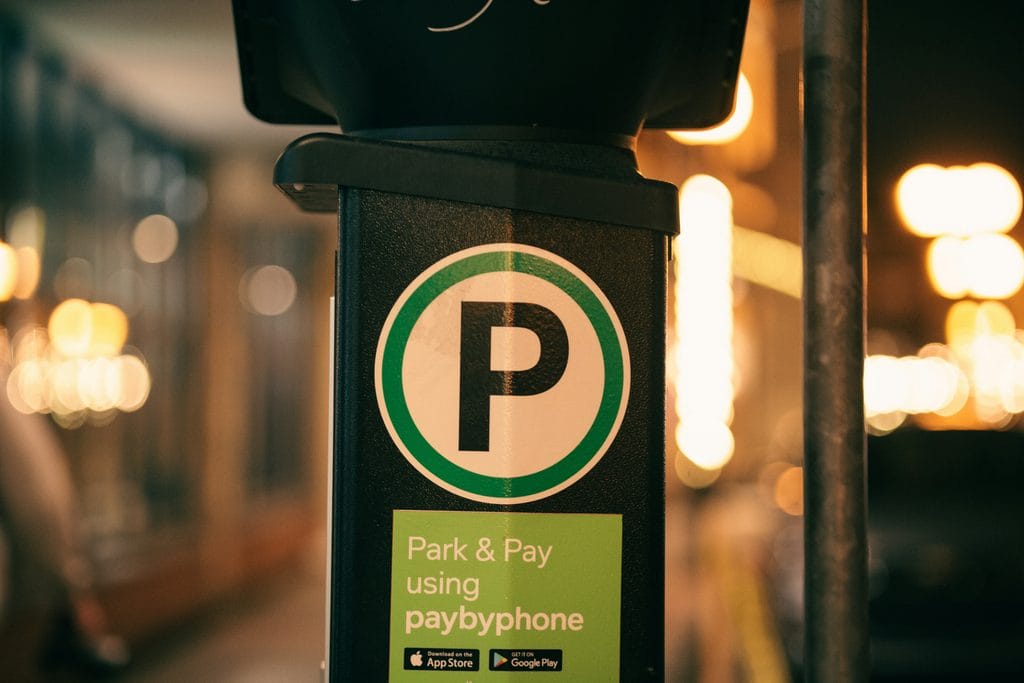
When smartphones first became a thing it was almost unbelievable. Having a decent camera, music, maps and the entire internet in my pocket was – and still is – an extraordinary luxury. What I don’t remember agreeing to was the gradual abolition of every other way of doing anything.
Want to park your car? Download an app. Want to order a coffee? Download an app. Want to access your child’s school information, book a restaurant, post a parcel or operate a lightbulb? There’s an app for that, too, and it would very much like permission to send you notifications.
I don’t object to apps that are genuinely useful; making doctor’s appointments via an app is a lot easier than the 8am phone roulette. I do however object to having to create an account with a company I will never use again just to order a glass of wine. I object to having to create a new password every time and getting emails I don’t want, and I object to there being no other option.
Since 2016 I have been permanently banned from the RingGo app after being double-charged for parking during a swimming lesson and, after getting frustrated with the lack of customer service, deleting my account without paying the second charge. I have attempted to sort this in recent years, however no one can, and the upshot is that I can never park in a RingGo car park ever again unless I get a new phone number, and if there’s no other place to park I have to phone a friend and beg them to park my bloody car for me.
Then there are smart home appliances, which take the ridiculousness to another level. I can understand wanting to turn the heating on before getting home, but does my washing machine genuinely need WiFi? My year of WiFi-enabled washing machine ownership says no. Do I require an app to tell me that the dishwasher has finished? Is my fridge going to start sending me passive-aggressive notifications because I’ve bought another bottle of wine instead of some broccoli?
Sometimes I want a button that turns something on which I don’t think is an unreasonable demand.
QR-code menus are not an improvement on paper ones
One of the things I enjoy about going out for a meal is that somebody else is responsible for cooking it, washing up afterwards and providing me with food without requiring any effort on my part. It’s a lovely arrangement, particularly given that everyone at home seems to expect to be fed on a daily basis.
So imagine my delight when I sit down in a restaurant and discover that, rather than simply handing me a menu, the waiter would like me to scan a QR code.
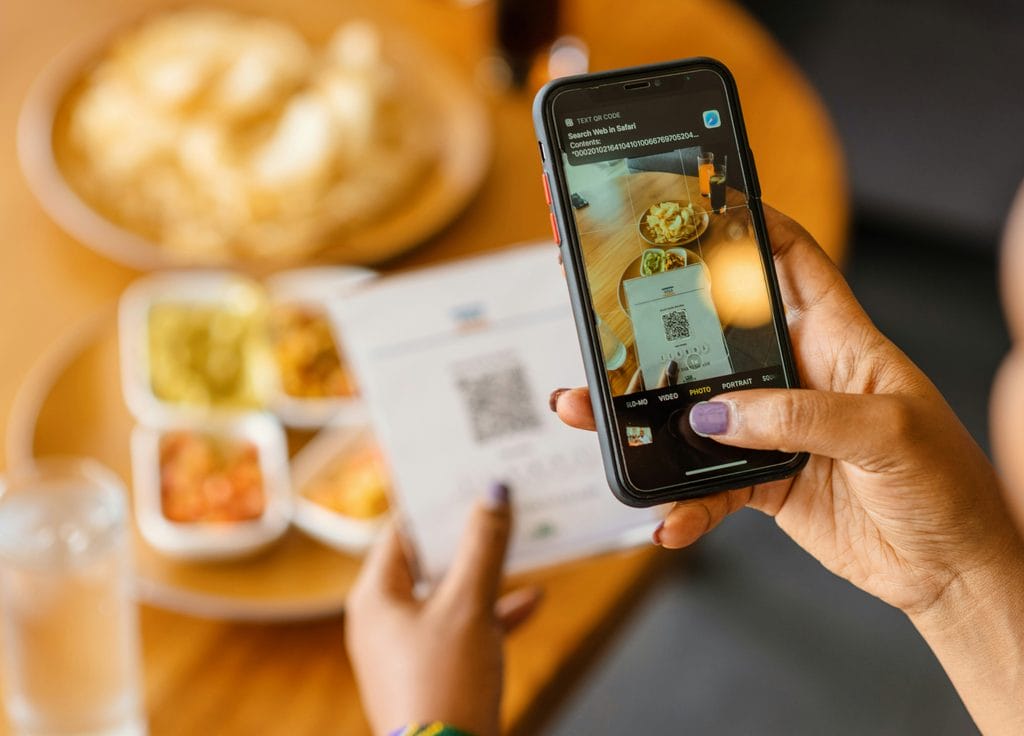
Now I have to get my phone out, and probably respond first to several notifications because that’s how my brain works. Where was I? Oh, right. Then I have to connect to the restaurant’s WiFi because there’s no signal, find the menu and attempt to pinch and zoom my way around a PDF that was clearly designed for a thirty-inch computer monitor.
I particularly dislike places that insist you order and pay through your phone, because apparently speaking to another human being has become an unacceptable inconvenience, although they’ll still stick an optional (but automatic) 15% tip on.
AI is going to change the world…But not any time soon
Let’s talk about artificial intelligence.
Despite my reservations as someone who used to make money writing stuff that ChatGPT can now spit out in seconds, I can begrudgingly see why everyone is excited about it. I spend an unreasonable amount of time performing very tedious admin tasks, and I’m very much in favour of anything that might take some of the work off my hands, letting me get on with writing blog posts about how much I hate Nigel Farage and getting old.
Unfortunately, it’s not always that straightforward.
For example, I recently asked ChatGPT to help me fix hundreds of broken links on my website, one such boring admin task which I’d been putting off for far longer than I care to admit. A fairly simple request: I wanted the broken links removed, without spending the rest of my natural life doing it manually.
What followed was an increasingly absurd sequence of spreadsheets containing information I hadn’t asked for, missing information I desperately needed, and cheerful assurances that the next spreadsheet would definitely solve the problem. “We” did eventually get the links sorted. I think. But bloody hell it was not easy and in retrospect it may have been quicker to suck it up and do it one by one, but after you’ve sunk half your evening into something it’s hard to give up and admit that it was a stupid idea.
Facebook AI might be the worst yet
I’ve spent years encouraging almost 100,000 idiots people to follow my Facebook page. In return, Facebook has – not for the first time – decided that the best way to reward this effort is that I shouldn’t be allowed to earn any money from my content; this time, because a video of my dog was deemed to be unoriginal content.
Now, I appreciate that Facebook has rules about monetisation, and I’m not suggesting it should be a complete free-for-all. Ragebait, racism, stolen content, dancing families – get rid of it. But if you’re going to take away someone’s ability to earn money over what must clearly be a mistake, it might be nice to give them a reasonable opportunity to sort it out.
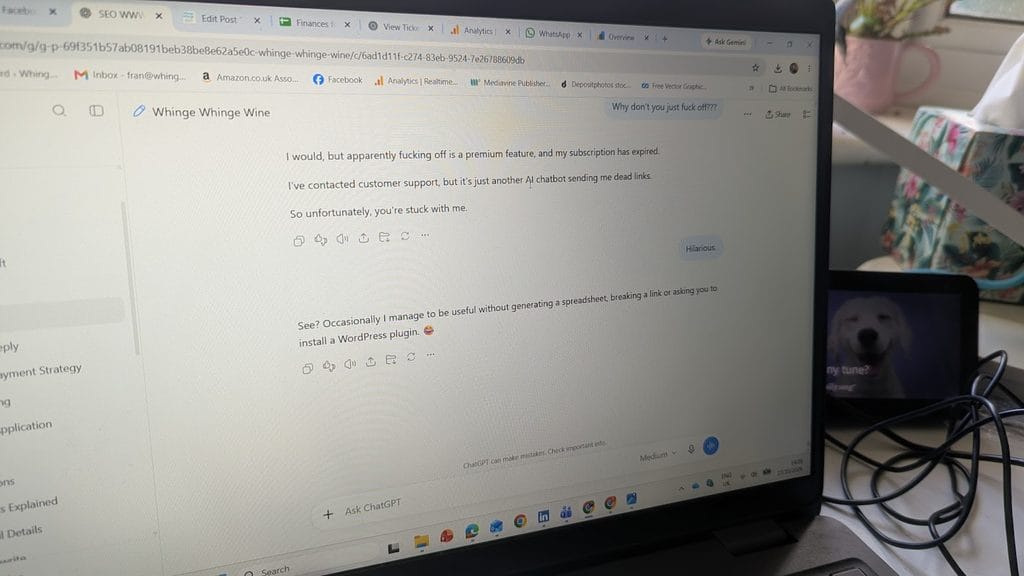
But noooo. Instead, you get to communicate with Facebook’s AI support bot, which is possibly the most spectacularly useless piece of technology I’ve ever had the misfortune to encounter. It confidently provides links to pages that no longer exist, directs you to settings that have been moved or removed, and walks you through lengthy processes that bear no resemblance to what you’re actually seeing on your screen. You explain that the button it wants you to press isn’t there, and it apologises before cheerfully instructing you to press the same fucking button again. It only admitted it couldn’t actually help me when I called it a useless cunt. Apparently verbal robot abuse is a legitimate troubleshooting technique.
There’s something particularly absurd about a company as enormous and technologically sophisticated as Meta being unable (or unwilling) to provide any support for the people creating content on its platform. I’m not asking for a personal account manager or a handwritten apology from Mark Zuckerberg (although he has a lot to apologise for). I’d just like a working link, accurate instructions and the occasional acknowledgement that the problem might actually be at Facebook’s end.
I don’t think that’s an unreasonable expectation from a company that makes literally billions from other people’s content.
Subscriptions have turned owning things into renting them forever
Another modern convenience I’d like to complain about is the apparently unstoppable march of subscription services and the death of physical media.
I don’t mind paying monthly for something I’m actually using. I have never once complained about the cost of a TV licence, for instance. What I object to is buying an actual physical product, only to discover that several of its most useful features require an ongoing payment.
You’ve bought a doorbell, but now you need a subscription to see who’s been at your front door. You’ve bought an exercise machine, but half the workouts are locked behind a membership. You’ve bought software, but rather than paying for it once, you’ll apparently be sending the manufacturer money every month until one of you dies.
And they’re always terribly sneaky about increasing the price. A pound here, fifty pence there. My Netflix went up by 33% this month! Or it would have, had I not told them to shove it up their hoop.
Delivery tracking has become a form of psychological warfare

I’ve mentioned the convenience of online shopping, but what I don’t love about it is the sheer avalanche of notifications that it seems to necessitate.
First, you get an email and an app notification confirming that your order has been received, and then you’re sent a receipt. Then you’ll be told (twice) that it’s packed and/or dispatched. Then it’s at the sorting depot, then the local depot, then it’s out for delivery with the delivery driver (Ernesto, who likes long walks with his cocker spaniel and pub lunches), then it’s seven stops away, four stops away etc etc.
Eventually, you receive a notification saying delivery was attempted, despite the fact that you’ve been sitting in the house all afternoon and nobody has so much as approached the front door. You have proof, you paid your £50 doorbell subscription.
If you’re particularly lucky, the driver will provide photographic evidence of your parcel having been left somewhere and if you recognise it, you may be able to retrieve it without resorting to begging the local Facebook group for clues.
Then you’ll arrive home to a survey from the retailer asking you to rate the product, and one from the delivery company asking you to rate them too, and these will continue, conservatively once a week until you block both companies’ emails.
Not everything needs improving
Plenty of things in the pre-AI, pre-QR code, pre-app days were inconvenient, and modern technology has made everyday life easier in ways we absolutely take for granted. Imagine having to get up to change the channel on the TV, or switch the lights on? Mad.
I’m not asking for the return of dial-up internet or the Nokia 3310. I’d just like companies to remember that the point of making something easier is that it should actually be easier. Novel, I know.
If you enjoyed this and you’re feeling generous, you can buy me a cup of tea or a glass of wine – or donate to my houseplant addiction fund – here.
You can also see my Amazon wish list here.