
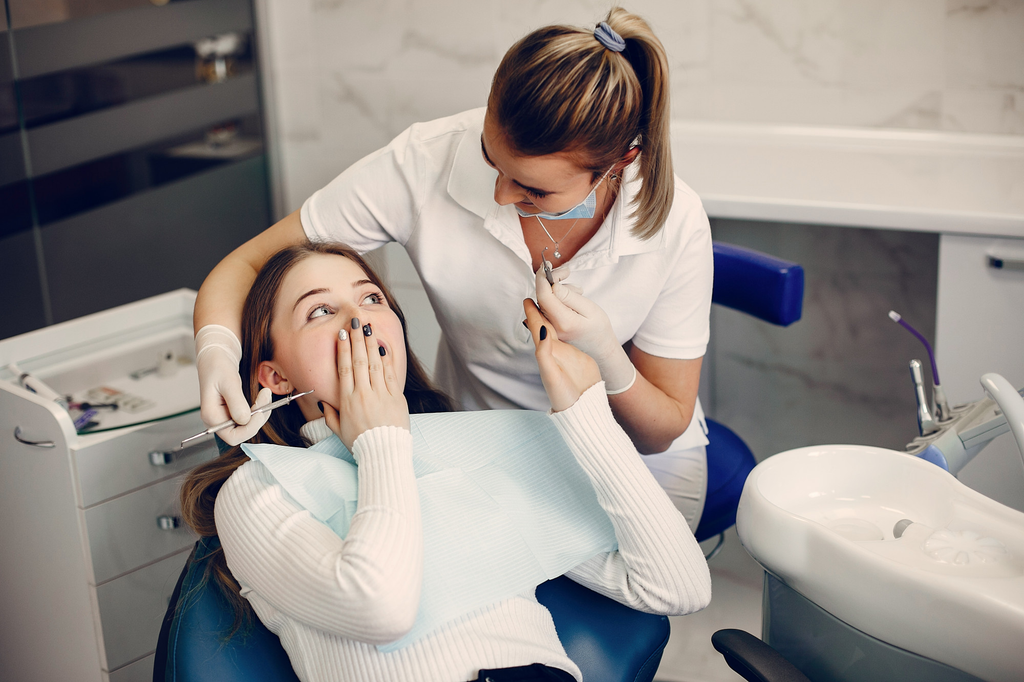
You usually know the feeling before you can name the reason. The parking lot. The clipboard. The particular pitch of a handpiece running two rooms away. By the time anyone looks in your mouth, your shoulders have been somewhere up near your ears for twenty minutes.
Dental anxiety gets treated as a personality quirk, which is unhelpful, because it happens to be one of the better-studied fears in health care. Some of the standard advice holds up under scrutiny. Some of it is reassurance wearing a lab coat. Here is the difference.
You Are in Very Large Company
A systematic review and meta-analysis published in the Journal of Dentistry pooled 31 studies covering more than 72,000 adults and estimated that roughly 15 percent of adults live with dental fear and anxiety, with about 3 percent experiencing it severely. Women and younger adults reported it more often.
A census-matched survey of just over 1,000 American adults, published in the Journal of the American Dental Association in 2025, asked the question more broadly and found something closer to three in four adults reporting at least some fear, with about 27 percent describing theirs as severe. That same survey found roughly one in five adults had avoided dental care because of anxiety.
Those two figures are measuring different things rather than arguing with each other. What they agree on is the useful part: this is common, it is not a character defect, and the person holding the mirror has already seen it several times this month.
What the Research Actually Supports
The strongest evidence sits with psychological approaches. A systematic review in the European Journal of Oral Sciences found that behavioral interventions, including exposure-based therapy and cognitive behavioral therapy, reduced dental anxiety in fearful adults and made them more likely to go through with treatment. A 2024 meta-analysis in Evidence-Based Dentistry reported reductions from behavioral therapy and from inhalational sedation as well.
Read the caveats the reviewers write about their own field, though. They repeatedly describe the underlying evidence as limited in quality and call for better trials. In plain language: these approaches help a meaningful number of people, the effect is real, and nobody credible claims a single session dissolves a phobia. Anything promising that is selling something.
Sedation deserves an honest note. Nitrous oxide and oral sedation are good at getting an anxious person through an appointment, which matters enormously if years of avoidance have left you with work that genuinely needs doing. They do not treat the fear itself. Plenty of people use sedation to clear the backlog and then deal with the anxiety separately. A private dentist Manchester will be able to arrange this. That is a sensible order of operations, not a cop-out.
The Unglamorous Things That Help
None of the following is a clinical intervention. They are the moves experienced anxious patients tend to arrive at on their own, and they cost nothing:
- Take the first appointment of the day. You are not sitting in the lobby accumulating dread while the schedule slips.
- Agree on a stop signal before anything starts. Raise a hand, everything pauses. Fear is largely about control, and this hands some back.
- Ask for narration, or ask for silence. Some people are calmer knowing exactly what comes next. Others want to be left alone with a podcast. Both are reasonable requests.
- Bring your own headphones. Sound is the trigger for a lot of people, and the ceiling speakers will not cover it.
- Say the word “anxious” out loud at the front desk. It changes how the hour runs more than most people expect.
The thread running through all of them is predictability. Anxiety feeds on not knowing what is about to happen or how long it will last, which is also why a well-run practice feels different from a chaotic one before anybody has said a word to you. When a hygienist is not disappearing mid-appointment to hunt through a cabinet for something that should have been restocked last week, it is usually because the practice runs its stockroom on dental supply software rather than on somebody’s memory. You never see that part. You only feel the appointment not stalling.
If You Get to Choose Where You Go
Anxious patients often stay put somewhere that stresses them out, because switching feels like more exposure rather than less. It is worth the one-time cost.
Worth asking on the phone, before you commit to anything:
- Do you see anxious patients often, and how do you usually handle it?
- Can I come look at the room before I book?
- Will I see the same person each visit?
That last question matters more than it sounds. Continuity is most of what makes an appointment survivable, because a second visit with someone you have already met is a fundamentally different experience from a first visit with a stranger.
Then judge the place on how it runs. Does the schedule hold. Is the assistant relaxed enough to answer a question, or visibly behind? Calm is contagious and so is its opposite, and it is usually a systems story rather than a personality one. The practices where staff have attention to spare tend to be the ones that pushed the busywork, dental supply ordering and the rest of it, off the humans and onto something else.
Where This Leaves You
You do not have to enjoy the dentist. That was never the goal and it was never on offer. The goal is an appointment you can complete without a week of dread in front of it, and that is achievable for most people through fairly ordinary means: psychological approaches with real support behind them, sedation when the backlog demands it, and a handful of small controls you can ask for by name.
Start with the phone call. Say the word. It is the most useful thing on the list, and it is the only one that has to happen first.