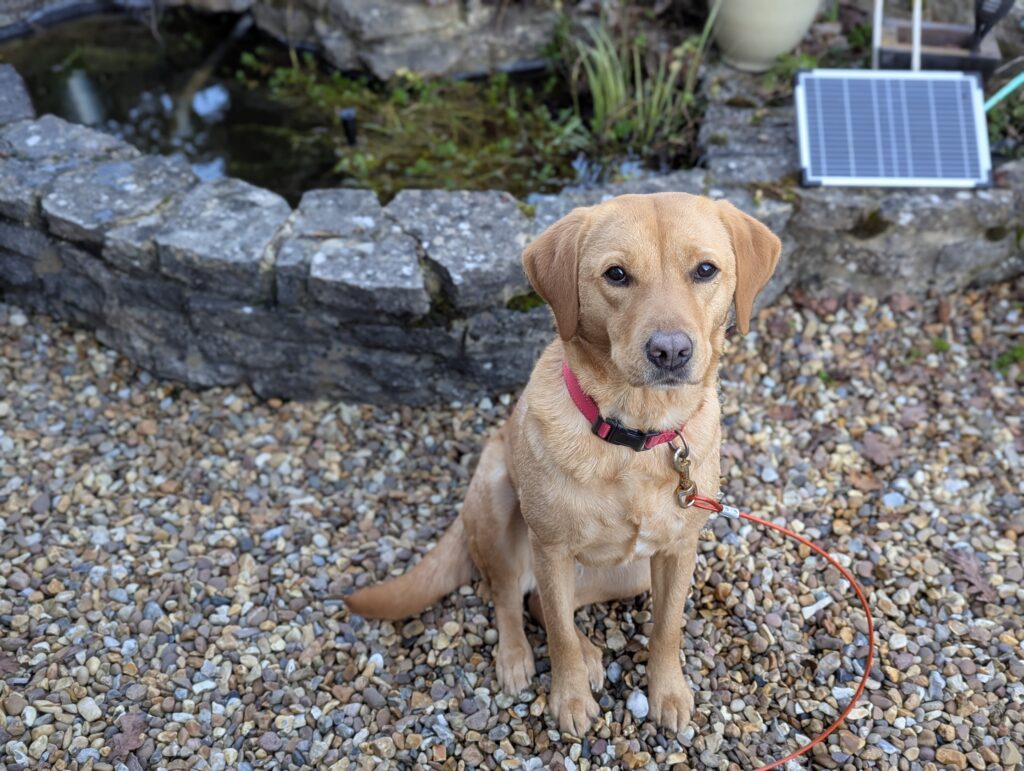
I should preface this by saying that I have never actually lost Izzy. I feel like that’s important context. But have I stood in the woods behind the village shouting her name in an increasingly unhinged voice while she cheerfully ignored me from a bush approximately six feet away? Yes. Multiple times. Have I had the cold-sweat moment where she disappeared around a corner on a walk and my brain immediately jumped to “she’s gone forever, I’ll never see her again, I should start printing posters”? Also yes. She was sniffing a discarded chip wrapper.
I am, it’s fair to say, a slightly paranoid dog mum.
The thing is, Izzy is lovely but she’s not what you’d call street smart. She’s a Labrador. Her primary motivations are food, other dogs, and whatever that interesting smell is over there. Recall is excellent – right up until something more exciting than me appears, which is most things, including but not limited to: pigeons, other people’s sandwiches, a particularly bold squirrel, and one time a crisp packet blowing across a car park.
So I’ve become one of those people. The ones with systems. The ones who think about worst-case scenarios before a walk. The ones whose browser history includes “what to do if your dog runs away” at 11pm on a Tuesday. Here is everything I’ve learned, obsessed over, and actually implemented.
The Basics That Everyone Thinks They’ve Done (But Probably Haven’t Properly)
Microchip details. When did you last check yours? Be honest. If you’re anything like me, the answer is “I’m sure I did it at some point, probably.” The problem with microchips is that they only work if two things happen: someone takes your dog to a vet or shelter with a scanner, AND the phone number attached to the chip actually reaches you. I finally logged in and checked Izzy’s after a full year of meaning to, and discovered it still had the breeder’s details on it. Brilliant.
Collar and tag. UK law says your dog needs a tag with your name and address on it when in a public place. Not your dog’s name – your name. (Apparently putting the dog’s name on makes it easier for someone to call them and gain their trust. I’m not sure Izzy would care who was calling her name if they had a sausage, but fair point.) The engraved tag is fine, but after Izzy’s second one became illegible from being bashed against her water bowl and the garden fence, I started looking at other options.
I ended up getting her a digital tag that links to an online profile – the kind where someone scans a QR code with their phone and gets my contact details, her vet info, and the fact that she’s friendly but deeply, profoundly stupid. The thing I like about it is that I can update it without ordering a new tag. So when we went to Cornwall last summer, I added the address of the holiday park and the nearest emergency vet before we left. Probably overkill. Definitely made me feel better.

The Gear That Helps (And The Gear That Lives In A Drawer)
I have tried several things. Some of them I still use. Some of them are in the kitchen drawer of broken dreams alongside the spiralizer and the resistance bands.
GPS tracker: Useful, with caveats. I’ve reviewed one of these before and the honest verdict is: great idea, slightly annoying execution. The PAJ tracker we tried was genuinely handy for seeing where Izzy had been (asleep, mostly) and for peace of mind on off-lead walks. The downsides are that it’s a bit bulky on her collar, it needs charging every few days, and the subscription adds up. But if your dog is an escape artist or you use dog walkers and want to be nosy about the route, they’re worth considering. I keep ours charged for holidays and unfamiliar walks rather than using it daily.
A decent harness. Izzy once backed straight out of a standard collar when she got startled by a bike. Just – pop – and she was free, looking as surprised as I was. We now use a harness with a front clip for walks anywhere near roads. It’s not glamorous and it doesn’t help with the dog-hair-on-everything situation, but it’s significantly harder for her to Houdini out of.
A long training lead. For beaches, open spaces, and anywhere I want her to have some freedom without the full commitment of going off-lead. Ours is 10 metres, which is long enough for her to have a good sniff and short enough that I can reel her in before she introduces herself to someone’s picnic. A £12 purchase from Amazon that I use more than almost anything else.
A whistle. I bought an Acme 211.5 – the frequency that apparently carries best over distance – and spent three weeks conditioning Izzy to associate it with the highest-value treats we had (cheese, obviously). It’s now more reliable than her name for recall, which says less about the whistle and more about how much she respects me as a person.
An AirTag. I know these aren’t designed for pets. Apple will tell you they’re for keys and bags. But I also know approximately forty-seven dog owners who’ve stuck one on their dog’s collar anyway, because the “Find My” network is genuinely massive and if your dog ends up anywhere near another iPhone, you’ll get a location ping. It’s not real-time tracking like a GPS, but at £35 with no subscription, it’s a cheap backup layer. I have one on her collar and I have no regrets.
The Situations That Actually Scare Me
It’s not the walks that worry me most. It’s the in-between moments.
The front door. Izzy is a bolter. Not maliciously – she just sees an open door as an invitation. If someone rings the doorbell and the kids open it before I get there, she’s out and trotting down the drive with absolutely no plan. We now have a baby gate between the hallway and the front door, which is annoying for humans but has prevented at least three escape attempts that I know of.
The car. Before we got the Travall dog guard, Izzy had unrestricted access to the entire car, which was a safety nightmare and also meant my children were covered in dog hair before we’d even arrived anywhere. The guard keeps her secure in the boot, and the divider means luggage doesn’t slide into her space. It also means she can’t steal the packed lunch before we get to wherever we’re going, which she absolutely would given half a chance.
Holidays and unfamiliar places. This is the big one. A dog in a new environment doesn’t know where “home” is. They haven’t mapped the garden, they don’t know which gate doesn’t latch properly, and they haven’t established a territory. The Cornwall trip was Izzy’s first proper holiday and I was a nervous wreck for the first 24 hours. I checked every fence, every gap, and every dodgy-looking hedge before she was allowed off-lead in the garden. She, naturally, was completely fine and spent most of the weekend trying to eat sand.
Dog-friendly restaurants and pubs. I love taking Izzy to places like The Oarsman in Marlow, but the logistics of keeping a Labrador calm in a dining environment while also trying to enjoy your own food requires military precision. The biggest fear is that she’ll lunge at something and yank the lead out of my hand near a road. Short lead, secured under a table leg, with a chew to keep her occupied. Works every time. (Mostly.)
The “Just In Case” File On My Phone
This is the paranoid bit that I’m only mildly embarrassed about. I have a note on my phone called “IF IZZY GOES MISSING” and it contains:
- A recent, clear photo of her (not the one where she looks majestic in golden hour; the one where you can actually see what she looks like)
- Her microchip number
- The vet’s phone number
- My partner’s phone number, my mum’s phone number, and the neighbour’s phone number
- The number for our local dog warden
- A reminder to check local Facebook lost dog groups immediately
- A reminder that panicking won’t help (this one is aspirational)
I have never needed this note. I fully intend to never need it. But it exists, and knowing it’s there makes me feel approximately 15% less anxious on every walk.
The Honest Truth
You can buy all the trackers and tags and harnesses you like – and I have, because apparently that’s who I am now – but the thing that actually keeps your dog safe is boring. It’s training. It’s consistency. It’s practising recall when there’s nothing exciting happening so it works when there is. It’s checking the garden gate. It’s not assuming your dog won’t do something stupid just because they’ve never done it before.
Izzy has many wonderful qualities. She’s affectionate, she’s good with the kids, she’s excellent company on a sofa. But she is a Labrador, and Labradors are governed by their stomachs, their noses, and an unshakeable optimism that everything will be fine. It’s my job to make sure she’s right about that.
And if it means I’m the slightly paranoid mum at the park with the whistle, the GPS tracker, the digital tag, and the phone note – well, there are worse things to be. Like a mum who’s lost her dog.
Touch wood.