
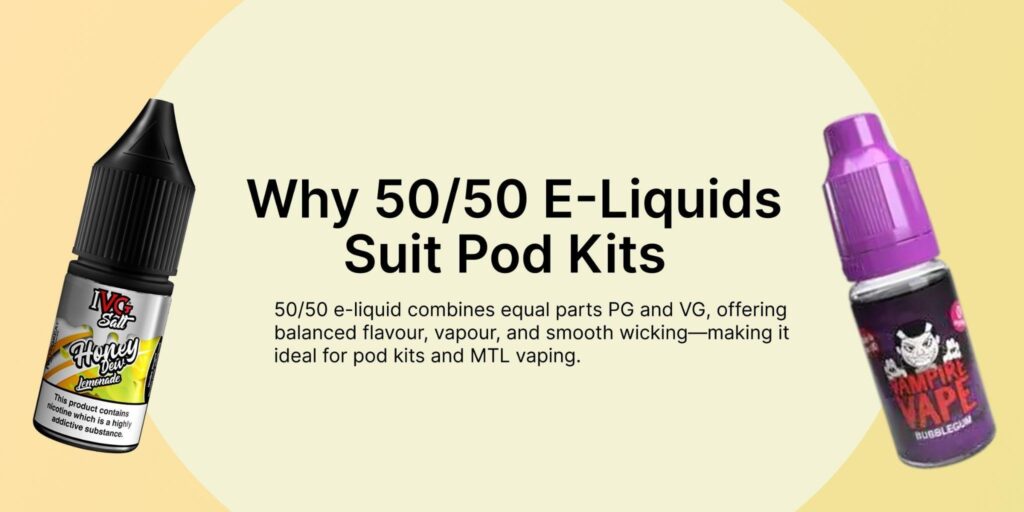
A 50/50 e-liquid contains equal parts propylene glycol (PG) and vegetable glycerine (VG). The balanced ratio creates a thinner liquid than high-VG blends, while retaining enough VG for moderate vapour production. Pod kits suit 50/50 vape juice because many pod coils use small wicking channels, low power, and a mouth-to-lung (MTL) draw. The liquid consistency supports efficient wicking, while the PG content supports flavour and throat sensation. Understanding the ratio starts with the role of each base liquid.
What Do VG and PG Do in E-Liquid?
PG is the thinner base liquid that carries flavour and provides more throat sensation, while VG is the thicker base liquid that increases vapour production and smooths the inhale.
Propylene glycol (PG)
Propylene glycol (PG) has a thin consistency. E-liquid uses PG to carry flavour compounds and provide a more noticeable throat hit. Higher PG ratios therefore produce a thinner liquid with stronger flavour and throat sensation.
Vegetable glycerine (VG)
Vegetable glycerine (VG) has a thicker consistency. E-liquid uses VG to increase vapour production and create a smoother inhale. Higher VG ratios produce thicker liquids that require suitable coil designs for effective wicking. The two liquids therefore affect both the physical properties of e-liquid and its performance inside a vape coil. PG keeps the liquid thin, while VG increases viscosity and vapour output. A 50/50 formulation gives both liquids an equal share. The resulting balance explains why the ratio suits many pod systems.
What Does 50/50 Mean in E-Liquid?
50/50 e-liquid contains 50% PG and 50% VG, creating a balanced formulation with moderate viscosity, flavour, throat hit and vapour production. The numbers describe the proportion of the two base liquids. A 50/50 bottle contains an equal PG/VG split. The ratio does not indicate nicotine strength or flavour concentration. The equal split places 50/50 e-liquid between higher-PG and higher-VG formulations. A higher-PG liquid becomes thinner and gives a stronger throat sensation. A higher-VG liquid becomes thicker and produces more vapour. Pod kits often need a liquid that avoids both extremes. Small coils need manageable viscosity, while lower-power devices work best with moderate vapour output. A 50/50 formulation addresses both requirements. The connection becomes clearer when the liquid reaches the pod coil.
Why Does 50/50 E-Liquid Suit Pod Coils?
50/50 e-liquid suits many pod coils because its thinner consistency can move through small wicking channels more easily than high-VG liquid. A pod coil contains a wick that absorbs e-liquid before the coil heats it. The wick needs a steady supply of liquid during normal use. Liquid viscosity affects how quickly the e-liquid can move through the wicking material. VG has a higher viscosity than PG. Increasing the VG proportion therefore creates a thicker e-liquid. High-VG blends such as 70/30 can require larger wicking channels and higher power to support the coil.
A 50/50 blend contains an equal amount of PG and VG. The PG component reduces the overall viscosity compared with high-VG blends. The resulting liquid can suit the smaller wicking systems used by many pod coils. Coil design still determines compatibility. A pod that supports a specific VG/PG range should be used with the manufacturer’s stated ratio. The 50/50 formulation provides a common starting point for many MTL pod systems. Efficient wicking then affects the consistency of each draw.
How Does 50/50 E-Liquid Support Consistent Wicking?
A suitable 50/50 e-liquid can maintain steady liquid flow through a pod coil when the coil is designed for the ratio. Wicking problems occur when the coil cannot receive e-liquid at the rate required by its power and usage. A thick liquid can move too slowly through a small wicking system. The wick may then struggle to remain saturated during repeated draws. A 50/50 blend has a thinner consistency than high-VG liquid. The formulation can therefore move through smaller wicking openings with less resistance. Proper liquid flow helps the coil receive the e-liquid required for normal vapour production. Dry or burnt flavours can result from poor wicking. Liquid ratio is one factor in that process. Coil condition, power level, airflow and draw frequency can affect coil performance as well. The main relationship remains simple: coil design determines the required liquid properties, while VG/PG ratio determines part of those properties. The same ratio affects what the pod produces once the coil heats the liquid.
How Does the 50/50 Ratio Affect Flavour and Vapour?
A 50/50 blend provides a middle ground between PG-led flavour and throat sensation and VG-led vapour production. PG carries flavour compounds effectively. The PG content in a 50/50 liquid therefore supports clear flavour delivery through a lower-power pod coil. VG contributes more to vapour production. The 50% VG content gives a 50/50 liquid enough VG to produce moderate vapour without creating the thick consistency associated with high-VG blends. The equal split affects throat sensation as well. PG produces a stronger throat hit than VG, while VG provides a smoother inhale. A 50/50 formulation balances these characteristics rather than favouring one strongly. The result suits the controlled output of many pod kits. MTL pods generally produce less vapour than high-powered sub-ohm devices. A 50/50 liquid supports that lower-output format while retaining flavour and throat sensation. The device’s inhalation style therefore matters as much as the liquid itself.
Why Is 50/50 E-Liquid Suited to MTL Pod Vaping?
50/50 e-liquid suits many MTL pod kits because the ratio matches the lower power, tighter airflow and smaller coil designs used for mouth-to-lung vaping. Mouth-to-lung (MTL) vaping involves drawing vapour into the mouth before inhaling it into the lungs. MTL devices use a tighter draw than direct-to-lung devices, which creates a more restricted vapour intake. Many pod kits use MTL coils or pods for this style. These components commonly operate at lower power than sub-ohm coils. The smaller coil structure requires an e-liquid that can wick without relying on high heat. A 50/50 blend provides the required balance. The PG content keeps the liquid relatively thin and supports flavour. The VG content contributes moderate vapour and a smoother inhale. The combination keeps the liquid and device within the same performance context. The pod does not need to produce large clouds to make use of the VG content. The 50/50 formulation instead supports the controlled output expected from MTL vaping. High-VG vape juices have different requirements.
Why Can High-VG E-Liquid Struggle in Pod Kits?
High-VG vape juice can struggle in some pod kits because its thicker consistency can move through small coil openings more slowly. A 70/30 e-liquid contains 70% VG and 30% PG. The higher VG content gives the liquid a thicker consistency than a 50/50 blend. High-VG formulations therefore suit coil systems with larger wicking channels and power levels designed to vaporise more liquid.
Small pod coils can have tighter wicking openings. Thick vape juice can move through these openings more slowly. The coil can then receive less liquid than required during repeated draws. Poor wicking can produce dry or burnt-tasting vapour. Coil performance can decline when the wick struggles to remain saturated.
A 50/50 blend has a thinner consistency than a 70/30 formulation. The thinner liquid can provide a closer match for many small pod coils. The comparison does not make 50/50 universally better than high-VG e-liquid. Each ratio suits a different coil design.
How Does 50/50 Compare With 70/30 E-Liquid?
50/50 and 70/30 e-liquids differ mainly in viscosity, vapour production, flavour balance and device compatibility.
| Attribute | 50/50 E-Liquid | 70/30 E-Liquid |
| PG/VG ratio | 50% PG / 50% VG | 30% PG / 70% VG |
| Consistency | Thinner | Thicker |
| Vapour output | Moderate | Higher |
| Throat sensation | More noticeable | Smoother |
| Typical use | MTL pods | Higher-power devices |
| Wicking demand | Smaller channels | Larger channels |
The comparison shows why device design determines the suitable ratio. A 50/50 blend suits many lower-power pod systems, while a 70/30 blend suits devices built to handle thicker liquid. The distinction leads to another common question about nicotine formulations.
Why Is 50/50 Common in Nicotine Salt E-Liquids?
50/50 e-liquid is common in nicotine salt formulations because the ratio suits many low-power MTL devices used for nicotine salt vaping. Nicotine salt e-liquids are available in 50/50 formulations. The balanced base provides a relatively thin consistency for pod systems, while nicotine salt provides the nicotine format used in these products. The VG/PG ratio and nicotine type describe separate properties. The ratio determines the balance between PG and VG. Nicotine salt describes the form of nicotine used in the e-liquid. Many 50/50 nicotine salt products are available in strengths up to 20mg/ml in the supplied competitor material. Product strength remains separate from VG/PG composition. The combination explains the strong association between 50/50 e-liquid, nicotine salts and MTL pod kits. The liquid base suits the device, while the nicotine format suits products designed for higher nicotine strengths. Device compatibility still comes first.
How Should You Choose a 50/50 E-Liquid for a Pod Kit?
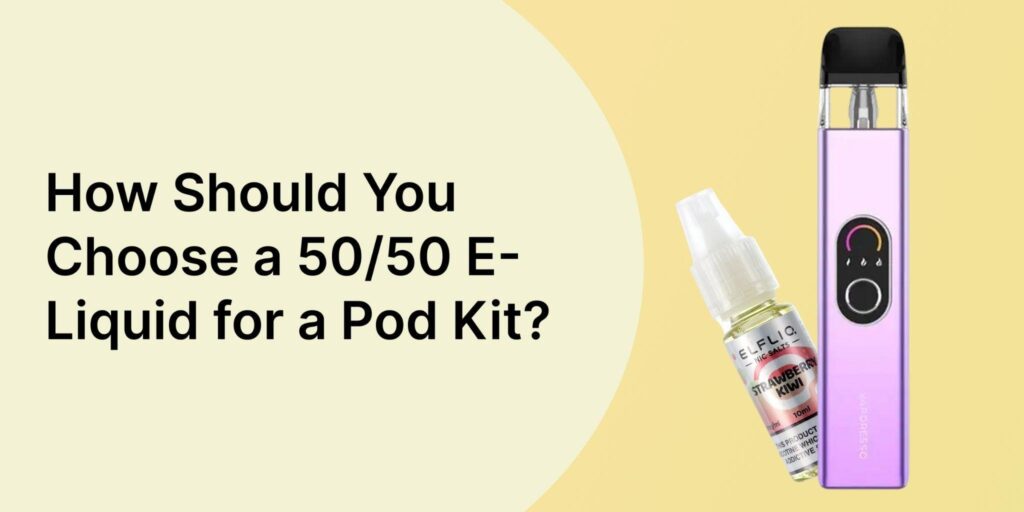
Choose 50/50 vape juice when the pod or coil manufacturer specifies a 50/50 or similar VG/PG ratio for the intended vaping style. Check three device attributes before filling a pod:
- Coil design: Check the coil’s recommended e-liquid ratio.
- Power range: Check the wattage recommended for the coil.
- Vaping style: Check whether the pod supports MTL or a more open draw.
These details provide a better compatibility guide than the 50/50 label alone. Pod systems differ in coil design, power output and airflow. A 50/50 liquid may suit one pod while another device may require a different formulation. Coil resistance can provide useful context, yet resistance alone does not determine e-liquid compatibility. Manufacturer guidance remains the more direct reference. The same rule applies when moving between different pod coils. Each coil has its own liquid and power requirements.
Is 50/50 E-Liquid Always Right for Pod Kits?
50/50 e-liquid is not suitable for every pod kit because pod systems support different coil designs, power levels and vaping styles. Traditional MTL pod systems commonly favour thinner e-liquids. A 50/50 blend suits this design when the manufacturer recommends the ratio. Some newer pod systems support more open airflow, lower-resistance coils and higher power. Such devices may accept thicker e-liquids. The correct ratio depends on the specific pod rather than the device category alone. The manufacturer’s coil guidance therefore provides the final check. The recommended VG/PG range accounts for the coil’s wicking structure and operating range. A 50/50 formulation remains a strong fit for many conventional MTL pod systems because the ratio aligns with their liquid flow and vapour requirements.
Why Do 50/50 E-Liquids Suit Pod Kits?
50/50 e-liquids suit many pod kits because equal PG and VG proportions provide a relatively thin liquid, balanced flavour, moderate vapour and a suitable throat sensation for MTL vaping. PG keeps the formulation thinner and supports flavour and throat sensation. VG adds vapour and smoothness without creating the thickness of a high-VG blend. Pod coils need suitable liquid flow through their wicking systems. A 50/50 formulation can meet that requirement when the coil is designed for the ratio. The result is a closer match between e-liquid viscosity, coil structure and device power. The key choice is therefore not simply 50/50 versus 70/30. The correct VG/PG ratio is the ratio that matches the pod’s coil and intended vaping style. For many lower-power MTL pod kits, 50/50 e-liquid provides the balance that makes that match work.