
As loft conversions typically cost around £40,000, they’re not an option for every family. But even if you don’t have the budget for a full loft conversion, you can still make better use of the space. By creating access and boarding over the joists, the loft can still be used for storage or as an occasional hobby room. This is known as a non-habitable loft conversion and because it requires minimal work and doesn’t usually need planning permission, it’s a cost-effective improvement that’s suitable for most homes. Here’s what’s involved in creating one.
Insulate and board over your joists
The loft is the void between your upper floor and your roof, so it’s not somewhere you may have ventured yet. But if you do take a look up there, you’re likely to see rows of timber joists and no floor. So, to be able to walk around your loft safely, it will need boarding over. Tongue-and-groove chipboard panels are typically used to do this as they’re quick and easy to install.
Before laying any boards, it’s worth checking to see if you need to install or upgrade your loft insulation. Most lofts are suitable for mineral wool blanket insulation. This sits between the joists and should be at least 270mm thick. To save squashing this insulation and to enable air to circulate effectively, it’s wise to sit your boards on loft legs or stilts rather than screw them directly onto the joists.
Create easy access
One thing you’ll certainly need to create a non-habitable loft space is easy access. You may already have a small hatch but a bigger opening with a pull-down ladder will make it easier to get in and out of your loft and enable you to store larger items up there. Loft hatches do come in different sizes, but a 1300mm by 700mm hatch is about the biggest opening you can buy as a kit. Just remember the hatch width needs to be slightly smaller than the width between your joists, otherwise it won’t fit. It may also be worth installing a three-sided balustrade around the opening, to increase safety when you’re in the loft.
When sourcing a kit, you might find those that have a fold-out ladder attached to the hatch door are the easiest to operate but do look for additional features such as safety handrails. And make sure the ladder length is suitable for the height of the room it’s opening out into. Most ladders fold or slide out as you open the door but if your hatch size is restricted, you may need to opt for a tilt-and-turn style ladder or a telescopic or concertina ladder instead.
Finally, it’s worth bearing in mind that a hatch can reduce the efficiency of your loft insulation. So, you might want a kit that comes with an insulated hatch and draught-proof seals. Also, check what the kit includes as not all are supplied with architrave trim and operating poles.
Add some light
Even if you’re just using a loft for storage, you’re going to need some light, so you can see what you’re doing. You have two options here: bring in natural light or add some artificial loft lighting.
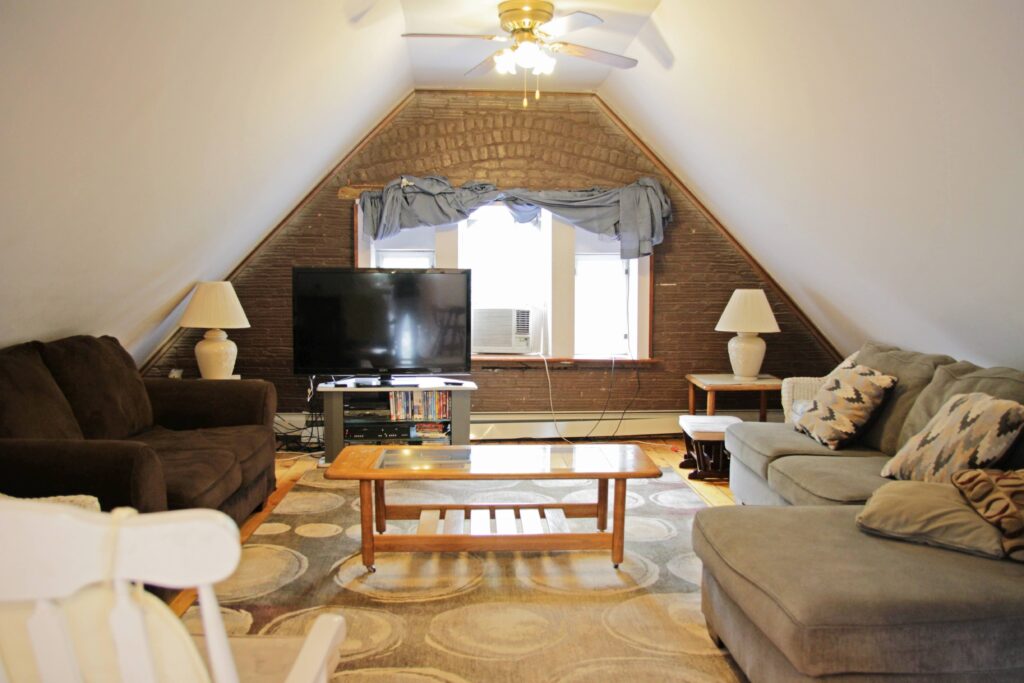
If you’re planning to use your loft as a hobby room, it’s probably worth installing roof windows, so you have a bit of natural light and ventilation in the warmer months. This is an extra cost but it may be worth it if you’re considering selling your home or carrying out a full loft conversion later down the line.
Even if you get a Velux window or similar roof light installed, it’s still wise to add in some artificial lighting in case you need to access the loft at night. You could go with a simple battery-powered LED light to save the need for wiring but you may find it better to go with a row of electric lights to provide more consistent illumination. This is a wise move in large lofts and for those being used as an occasional space such as a hobby room.
Put up shelves and organise your storage
Of course, if you’re using your loft space for storage, you’re going to need some shelves. If you’re planning to use free-standing shelving units, it’s wise to go with something strong but lightweight. Choose flatpack shelves that are easy to put together. This will save you from having to hoist large, readymade units up through your hatch. If you have a trussed roof, you may be able to build loft ledge shelving in between the timbers. There are kits available to do this if you want to keep things simple.
Along with shelves, it’s wise to think about using plastic boxes to store things in. These will prevent animals such as mice and squirrels from nesting in or chewing your belongings and will protect them from moths, damp and other issues. It will also ensure that everything stays organised and easy to find. In addition, you may be able to create some hanging storage by installing rails, racks and hooks. This could be handy for stashing things like sports and outdoor equipment.