
A patio is mostly won or lost before any slabs arrive. The part everyone pictures, laying them out and tapping them level, is the satisfying bit, but it’s the decisions made beforehand that decide whether the finished thing drains properly, sits flat in two years’ time and is actually the right size for a table you can get the chairs out from under. Plenty of patios go wrong not because the laying was botched, but because nobody worked out the boring stuff first.
What the patio needs to do
Start with how the space gets used, not how big it looks on a drawing. A patio that has to hold a table, six chairs and the room to push those chairs back is a lot bigger than the footprint of the table itself. People routinely measure for the furniture and forget the metre of shuffling space around it, then end up with everyone’s back legs on the grass.
Position matters as much as size. The corner that catches the late afternoon and evening sun is usually where you’ll actually sit, which isn’t always the spot nearest the back door. Worth standing in the garden at the time of day you’d use it before committing to a location.
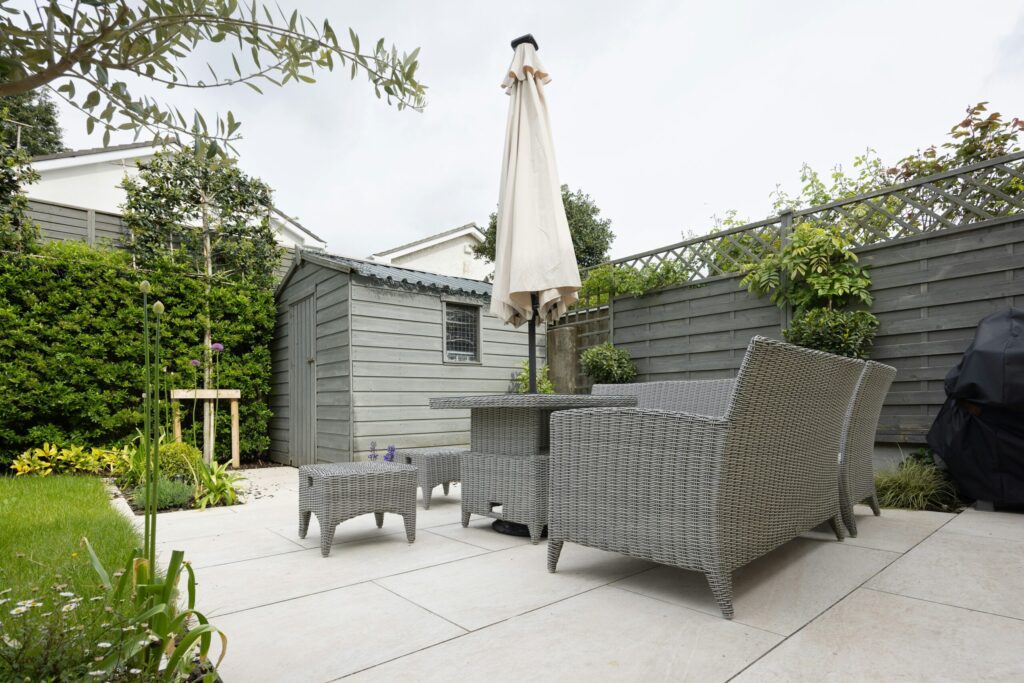
The ground decides more than the slab
Whatever goes on top, the patio is only as good as what’s underneath it. Laying paving straight onto soil or a thin bed of sand is how you get a surface that sinks, lifts and grows weeds through the joints within a couple of seasons. A proper sub-base of compacted hardcore does the structural work, and decorative aggregate is not the same thing, so the two aren’t interchangeable however similar they look in a bag.
Check the levels and any slope before ordering, because a garden that drops away or sits below the house changes what’s realistic and can turn a straightforward job into a levelling one. Two practical warnings here. Before any digging, check for underground services rather than putting a spade through something expensive. And paving slabs are heavy; lifting and moving a pallet’s worth is not a solo job, so plan for help or the right equipment.
Where the water goes
A patio changes how rain moves around the garden, and that needs thinking about rather than discovering later. The surface should fall very slightly away from the house so water runs off rather than pooling against the wall, and it shouldn’t be sending that water onto a boundary or a neighbour’s land either. If the area already sits wet or there’s nowhere obvious for run-off to go, drainage channels or a soakaway may be needed, and that’s a real part of the plan, not a detail to paper over. Standing water against a house wall is the kind of problem that gets expensive if it’s ignored.
Boundaries and fencing, if you’re doing both
Patios and fences often get done in the same go, so it’s worth sorting the boundary side before ordering. Check which fence is actually yours before you touch anything; the deeds usually say, and getting it wrong causes the sort of dispute that outlasts the patio. Don’t fix new panels or anything else to a neighbour’s fence or wall without agreement.
If the existing fence is failing, work out why. Replacing panels does nothing if the posts are rotten, since the posts are what hold everything up, and concrete posts with gravel boards last longer at ground level than timber sat in wet soil. Bear wind exposure in mind too: solid panels in an open, gusty spot take a battering, and a more open style can ride it out better.
Materials and getting the quantities right
Paving comes in natural stone, porcelain and concrete, and the choice is about use rather than looks alone. Porcelain is hard-wearing and low-maintenance but needs the right fixing approach; natural stone has more variation and often needs sealing; concrete tends to be cheaper. None of them is genuinely maintenance-free, whatever the brochure says. Match the slab to how the space will be used, including how slippery it gets when wet if there are steps or a route to the back door.
Once the area is measured and the build-up decided, it’s easier to price up and order everything in one pass rather than in dribs and drabs. A merchant carrying landscaping and fencing materials can usually cover the paving, sub-base, sand, edging and any posts and panels together, which keeps the quantities straight and saves arranging several separate deliveries. Work out how much you need from the measurements before ordering, allowing a bit of waste for cuts, rather than guessing and ending up short halfway through.
Budget, access and muck
The slabs are rarely the whole cost. Sub-base, sand, edging and the skip for the old surface and spoil all add up, and so does delivery if a pallet can’t get round the back and has to be wheeled through. Check access before you order a tonne of anything. And for anything structural, a retaining wall holding back a slope in particular, get a professional in rather than improvising, because that’s a job where getting it wrong is dangerous as well as costly.
Sort the ground, the drainage and the boundaries first, and the laying becomes the easy part. Skip them, and no amount of nice paving will save it.